
RGSR-01
Published Standard
Runtime Governance Standards Registry
The administrative registry governing publication identifiers, status, version history, and the standards family catalog.
Published · Version 1.0
Open Runtime Governance Standards · Reference Architecture · Implementation
ManChine develops open, vendor-independent Runtime Governance Standards and standards-aligned architecture for systems whose decisions can create real-world consequence. The objective is to preserve authority, admissibility, accountability, and continuity as evidence, policy, context, and operating conditions change.
Runtime Governance Standards Series
The Runtime Governance Standards Family provides the governing architecture, shared vocabulary, publication registry, editorial policy, and publication design rules for runtime governance. RGSR-01 and RGV-01 are published; RGEP-01 is in final editorial review; and RGDS-01 is in technical review.
Published Standard
Runtime Governance Standards Registry
The administrative registry governing publication identifiers, status, version history, and the standards family catalog.
Published · Version 1.0
Runtime Governance Vocabulary
Establishes the shared normative terminology used throughout the standards family.
Published · Version 1.0
Runtime Governance Editorial & Publication Policy
Establishes the review methodology, publication lifecycle, and editorial governance for the standards family.
Final Editorial Review
Runtime Governance Publication Design Standard
Defines the official cover-page design, branding, metadata, and presentation requirements for standards-family publications.
Technical Review · Version 1.0
Runtime Integrity Control
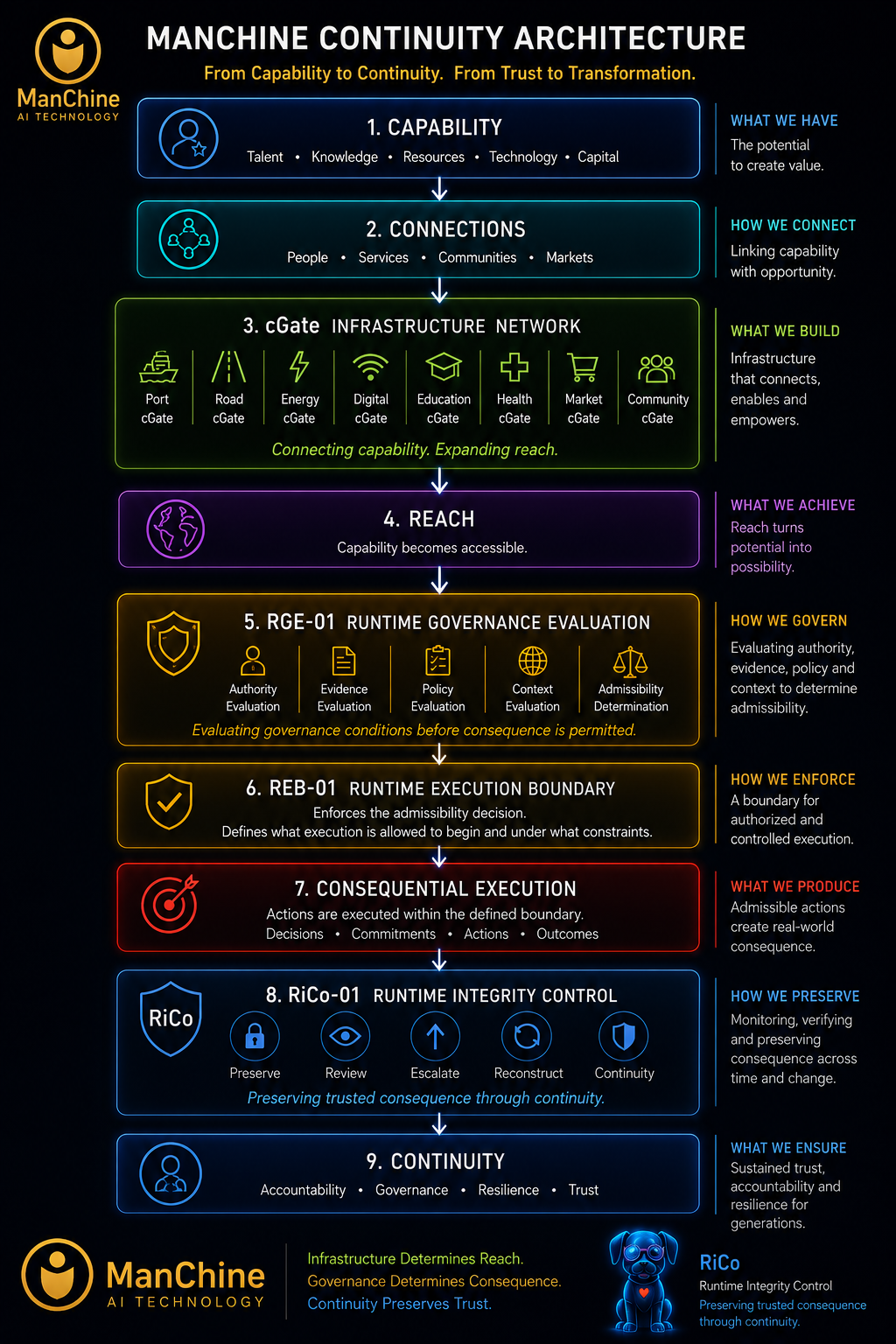
RiCo is the Runtime Integrity Control implementation. It is not an AI system and not a standards document. RGE-01 evaluates whether consequential execution is admissible before the Runtime Execution Boundary is crossed; RiCo preserves runtime integrity and legitimacy continuity after execution activation while consequence remains active.
Core Architecture
The architecture separates reach, evaluation, enforcement, and runtime continuity so that no product or component silently absorbs another responsibility.
Capability Reach
Connects capability, services, people, and institutions so systems can operate across real environments.
Runtime Governance Evaluation
Evaluates authority, evidence, policy, and context to produce the Admissibility Determination.
Runtime Execution Boundary
Enforces whether consequential execution may begin and under what constraints.
Runtime Integrity Control
Preserves runtime integrity and legitimacy continuity after execution activation.
A Concrete Runtime Example
Consider an autonomous healthcare workflow that recommends a consequential action. New patient evidence appears, delegated authority changes, and the operational context evolves.
RGE-01 evaluates current authority, evidence, policy, and context.
An Admissibility Determination states whether execution may proceed, pause, escalate, or be denied.
REB-01 enforces whether execution may cross the Runtime Execution Boundary.
RiCo-01 preserves runtime integrity and legitimacy continuity while execution remains active.
System Logic
cGate makes capability reachable. RGE-01 evaluates admissibility. REB-01 enforces the execution boundary. RiCo-01 preserves runtime integrity after activation.
ManChine Product Platform
PGC01 — Phone, Glasses, and Case — is a ManChine implementation platform. It does not define or replace RGE-01, REB-01, or RiCo-01; it may deliver those capabilities through coordinated physical products.
Primary interface for identity, applications, communication, and governed access.
Contextual interface for awareness, hands-free interaction, and governed assistance.
Support interface for power, protection, secure storage, resilience, and future hardware capabilities.
Services
ManChine provides standards-informed architecture, assessment, continuity review, infrastructure strategy, and strategic advisory for consequential systems.
Design decision, accountability, and review structures for AI systems and complex operations.
Identify where systems lose accountability, legitimacy, or operational coherence under changing conditions.
Support planning for connectivity, resilience, and capability reach across communities and institutions.
Help founders, teams, and institutions translate complex system goals into practical execution paths.
Open Development
Review selected prototypes, technical notes, and implementation work supporting RiCo's runtime-governance architecture and open validation efforts.
Research & Collaboration
ManChine engages with researchers, architects, engineers, practitioners, and organizations exploring runtime governance, continuity, accountability, interoperability, and consequential AI.
Why It Matters
Talk with ManChine about runtime governance, continuity architecture, research collaboration, or a narrowly scoped validation pilot.
Start a Conversation